
The Utah Jazz had made nine lottery appearances since 2010 and had either stayed in their projected draft position or fallen backward in each—they’d never moved up, never. But on the May 20th, the team finally got lucky. The contents of the 13th envelope opened that day signaled the Jazz had moved from their projected fourth slot to second—they moved up, not down, not out. Wild bells rang out, Jazz fans leapt from R.C. Willey-purchased sofas, high fives abounded, chest bumps were awkwardly attempted.
And Jazz Nation exulted.
At least for a while it did.
Such spontaneous joy certainly came, in part, as a release from the suffering endured during the last four seasons of on-and-off tanking and the silliness of intentionally losing now to win in some unknown future. Joy also came from hope. The hope of obtaining a franchise player. Hope buoyed by the long line of NBA analysts, insiders, and self-described draft savants who told us that this was a good draft, maybe a great draft. That the top three prospects, maybe top four, were sure bets, can’t misses. Picking second would surely secure the Jazz a future all-star or better.
But good news is only interesting for a time. It was not long before the same voices that trumpeted the prowess of this year’s draft class began to see and report red flags as they passed their microscopes over each prospect. And as Jonathan Swift’s Gulliver found while among the giants of Brobdingnag, when you get a very, very close-up look at someone, even someone named Dybantsa, or Peterson, or Boozer, beauty can be obscured by flawed physical realties.
Now the daily pounding from podcasted negativity wears on Jazz fan. Listen too often and you begin to wonder how any of these guys even dribble up the court without getting and 8-second call, or dropping the ball out of bounds, or cramping up and being hauled away to the ER. Such focus has turned the ecstasy of the Jazz’ lottery win to doubt, even dread. Why? Why the anxiety? Because Jazz fan knows that the team cannot afford to miss on this. And what seemed to be a candy store now looks like a mine field.
Should we all be terrified? Maybe. Are all principal draft candidates worryingly flawed or do their undeniable talents outweigh the perceived small chinks in their armor?
We take a look to attempt to calm your nerves… or not.
AJ Dybansta
The big wing from down the road at BYU couples elite athleticism with jump-off-the-screen offensive skill.
If you knew nothing about the 2025-26 BYU Cougar basketball team, other than they were very good and had one very, very, very good player on the team, it would take you about two seconds to pick that very, very, very good player out during warm-ups.
It’s that apparent. Dybantsa oozes specialness.
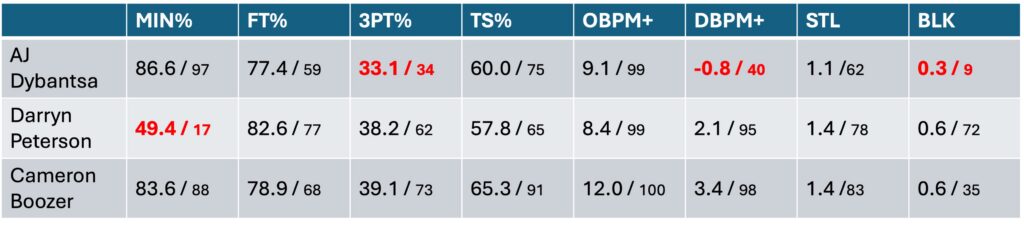
He glides up and down the court in strong and balanced fashion. He bounces to the rim and into high-release and accurate midrange jumpers. He reads the floor well and is a good and willing passer and play maker. Dybantsa’s impact on the offensive side of the ball is top tier. He generates 9.1 more points per 100 offensive possessions than the average college player would in that exact same role (see table 1, OBPM+)—that’s staggering. Only Cameron Boozer ranks out better in that offensive metric.
He is an elite rim finisher. He has the highest mid-range shooting percentage of any of the top draft prospects (top 15% of all prospects)
Buuuut… the long ball. Oh yeah… and the defense. Chink! Chink!
Dybantsa was a subpar shooter from distance in college—in the bottom 35% of college players shooting 33% from behind the line for BYU. Opposing team defenses sagged off Dybantsa, playing him for the drive, letting him take his flat three if he dared.
The lack of a deep threat jumper is not AJ’s only current weakness. His caliber of physical tools and competitive makeup point to him being a positive defensive player, and yet he is not. Dybantsa’s individual defensive presence (see table 1 DBPM+) cost his team an estimated –0.8 points per 100 possessions compared to a league-average defender (0.0). He is the only negative defensive impact player (using this statistical category) of the three the Jazz are likely choosing from. He does not block shots; he does not get a lot of steals. He is not yet a two-way player… not yet.
Terror or hope? Which one of these two things?
If the Wizards pass on Dybantsa at one (which I believe they will), Jazz fan should rejoice that there is still such talent on the board at #2 to choose from… despite the weaknesses.
He’s an offensive powerhouse. If he can bump that long ball percentage up a couple of tics (not too unusual for such a player over time) that offense will open even more. If not, we believe his bag will be enough to remain a substantial offensive force. Imagine Dybantsa on the court with Ace, Markkanen, and Triple J, regardless of the 33% deep shot–my, my!
And one would hope, and should be hopeful, that that his defensive value at the next level will play out based on his physical tools (9-foot standing reach, 42-inch vertical) rather than his single-season college box score output.
If Dybantsa is there at two, we here at Lower The Rim have no problem making that selection with great optimistism.
Darryn Peterson
Darryn Peterson is the most talented prospect in this draft class.
He is the eye-test winner. You watch him play and your head can’t help but nod up and down, your mouth whispers “yes”, and “wow”, and “can I have this player on my team please”.
You may not see it in warm-ups… he’s not as impressively large and springy as Dybantsa. But you’ll see it when the game starts. Peterson is how the game is supposed to be played from the backcourt. Let’s be clear, I’m not saying he’s Kobe (he’s not), but his jump shot looks a little bit like Kobe’s. On-ball, off-ball, catch and shoot, off the bounce, off the screen, off the curl, to the rack; it doesn’t matter, he looks like money and the offensive stats back up the visuals.
Peterson is also a top 10% impact (table 1, DBPM+) defensive player. He is a high steals guy using his speed and length to get into passing lanes and closing out on shooters. He, unlike Dybantsa, will come into the league with 2-way skills and mentality.
He would be my first pick.
Buuuut… the cramps… and the head?
At his best, no player in the draft can match Peterson’s scoring excellence, but those moments, although brilliant, were infrequent last year at Kansas.
Peterson experienced multiple injuries in his season at Kansas costing him games and minutes. Most disturbing was an early-season bout of “full body cramps” which Peterson described as “traumatic”. Multiple games were lost waiting for complete recover. And when Peterson did begin to play, he often restricted his minutes and even removed himself from games a few times when he felt he might be cramping again (see table 1, MIN% red-flag percentile ranking). Your “mind is a joystick,” Peterson said during a post-season interview with the Kansas Star, “You can’t beat your mind.”
The source and status of Peterson’s cramping issues and whether that trauma may continue to affect his ability to play are major concerns to would-be drafters. The information and explanations from Peterson on this issue are fuzzy, cryptic (please see this excellent Deseret News article by Sara Todd for current understanding of the injury and aftermath). But the word on the street is that pre-draft medical evaluations and physicals have generally assuaged fears and that teams that have done their due diligence (including the Jazz) are comfortable drafting him (Ramona Shelburne and Tim MacMahon ESPN).
Terror or hope?
This one is so hard.
Director and explorer James Cameron once said “hope is not a strategy, luck is not a factor, fear is not an option,”… or something like that. But it seems, unfortunately, that all these things are in play for the Jazz when considering Peterson. The Jazz may be in position to select Peterson at #2 because of luck (the randomness of the lottery). They can reduce the fear of making that selection with careful intelligence gathering on Peterson’s medicals and beyond. But the rest is hope really. Hope that their intel is right and the cramping issue and his apparent post-trauma stress response to it are in the past.
Peterson’s recent cancelation of a schedule workout with the Jazz right after meeting with the Washington Wizards might signal that the Jazz may not have to worry about deciding on Peterson. Washington may have given Peterson the nod that he would be their pick making any future workouts meaningless. Or, Peterson’s team may be posturing or signaling to others that he prefers Washington (heaven knows why). Regardless, the workout cancelation is a nothing sandwich, not to be considered in the Jazz’s decision. Pick them and they will come (see Ace Bailey).
At his best, Peterson is the best. The Jazz should take him at #2 if he is there… without hesitation.
Cameron Boozer
Boozer is the money ball pick, the darling of the analytics. The 6’9” power forward out of Duke is a box-score and advanced metrics monster. I have stated here that Peterson is the most talented prospect of these projected top three. And yet, it is Boozer who appears at or near the top in just about every meaningful statistical categories (offensive and even some defensive) and advanced metrics. There is no red ink on his stats table.
He was the hub of a very, very good Duke offense, initiating the offense, dishing and diving from the high post, stepping out for three’s, bullying people with his back to the basket. At 6’9” Boozer has better effective ball-handling and driving efficiency than Caleb Wilson, better three-point and assist numbers than Dybantsa, and the highest KenPom offensive/defensive efficiency rating ever recorded (metric computed since 2013).
If you just read a print-out of Cameron Boozer statistics, metrics, and accolades you would assume he is the greatest college basketball player in the last decade.
Buuuut… the legs… they are heavy. Chink!
Boozer is not plodding. But he is neither fast nor quick.
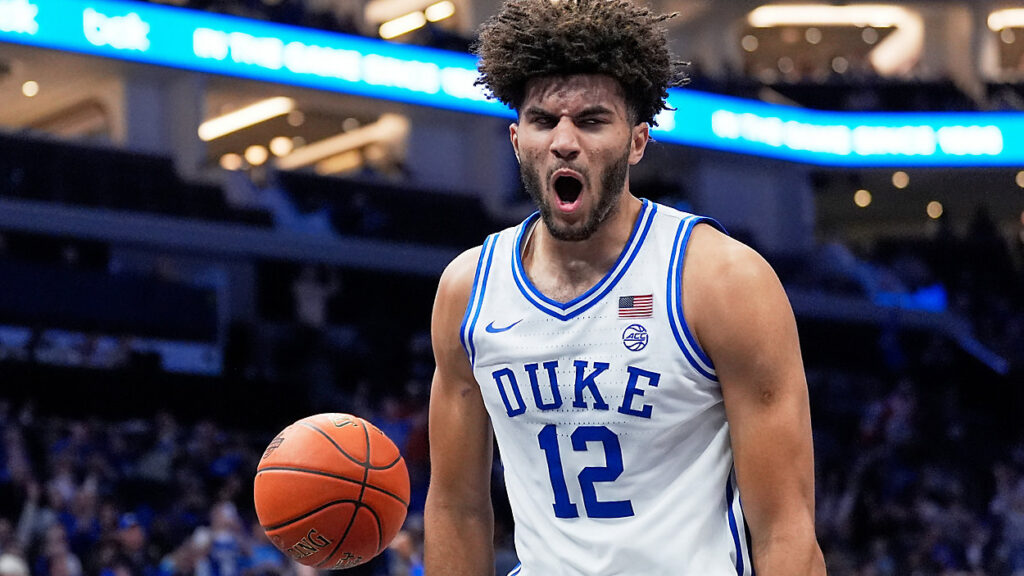
From outside, Boozer if fine. His midrange game is fine. Inside, Boozer is an at-the-rim and below-the-rim player, relying on footwork, niftiness with the ball, and skillful use of his bulk to rise to the offensive acme of college basketball. Some draft evaluators worry, however, whether that low-elevation mix will buy him the same results in the bigger and faster NBA.
When you shift your gaze from Boozer on paper to Boozer in real life, the poor optics of him struggling in the paint on offense and getting passed-by on defense against college talent are somewhat worrisome. Boozer may be an important motor in a future NBA offense, but will a team be able to count on him as a go to, get-your-own shot guy when they need it? Maybe not.
Terror or Hope?
Boozer has been labeled the safest draft pick of the three and as having the lowest floor. But there’s a list of slowish, big-man draft picks that have whiffed in the NBA (table 2). We don’t think he is a whiffer but his floor may be lower than most prognosticators estimate.
The winning difference with Boozer when compare with some of the high draft pick busts at the forward and center positions is his shooting. True, his game does not scream at you from the screen, but he just manufactures offense from all areas of the court including from behind the line. Boozer does not dazzle with athleticism and burst. But the impact of his shooting, passing IQ, physicality, decision-making and poise could outweigh the occasional issues that stem from athletic limitations.
The Jazz will have a difficult choice with Boozer regardless of who Washington picks. We have Boozer at #3 but we all should be feeling ok, but maybe not ecstatic, if the Jazz take him at #2.
Don’t worry… much
We’ve watched the games, dug deep into the statistics. The draft looks good… deep. Alas, maybe not as good as last season. There may be no Flagg and certainly no Wemby (will there ever be again?).
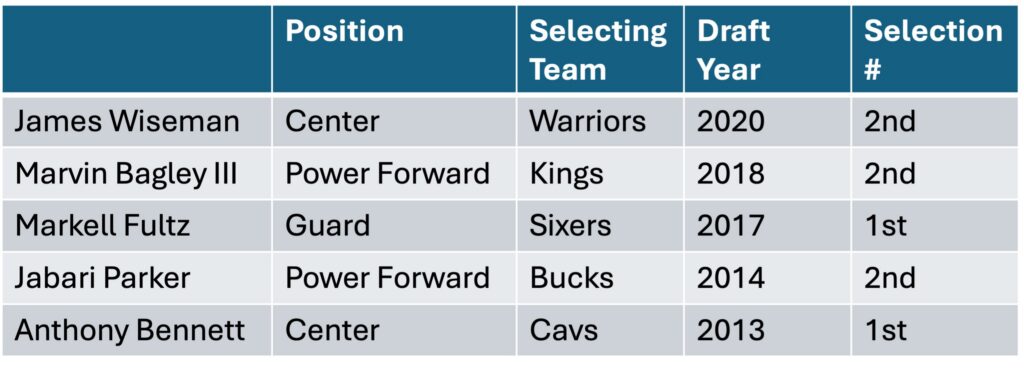
We understand that Jazz fans want somethings special out of this draft, a Malone, a Stockton, a D-Will, or a Spida. There may be those players at #2 this year. But history tells us that there are aways a few duds at the top of historic NBA draft boards (Table 2 – The Whiffs). The Jazz’ likely three candidates for selection on June 23rd can look like world beaters in some stretches of some games, and they can look almost ordinary in others. Dybansta’s shot, Peterson’s mind, Boozer’s less than fast legs; all real… all concerns. But recall that Malone and Stockton and Mitchell had red flags too. Malone was labeled “difficult” (uh yes), “soft”(crazy), “lazy” (what?). Stockton was too small and slow. Mitchell was a short tweener with poor shot selection and no left hand. That was all wrong. So don’t listen too closely to the myriad so-called experts. None of the folks talking to you are getting paid by an NBA team to assess talent.
The truth is that the tape and the odds are on the side of Utah. So Jazz Nation rejoice!
The measurements indicate the the Jazz are going to get a stud at #2 no matter how these three fallout. The odds indicate the same. Although there have been a few stinkers in the last decade or so, 13 of the 22 (~60%) players drafter first or second from 2013 to 2023 (we didn’t count first or second year nba players) have become all stars (and more will with time). Eight out of the 22 (37%) have become All NBA players (and more will with time).
Sure, anything can happen. But one can imagine a Jazz top six lineup with one of these three and smile. Let’s hope the Jazz select the best of these three very good players, whoever that is (it’s Peterson).