

Somebody lied to me.
Now, If I were Deputy U.S. Marshal Sam Gerard (Tommy Lee Jones) referring to Dr. Richard Kimble (Harrison Ford) in the Fugitive (great show), I’d have my guys go find the liar and bring them in for questioning.
I’m sure Austin Ainge is a man of high integrity like Dr. Richard Kimble. He has a good reputation among league managers as a straight shooter and good guy.
But he did tell a fib.
Wait a minute!
Mr. Ainge told me when he was hired as the Jazz’ President of Basketball Operations back in June 2025, the Jazz would not be prioritizing losing games to increase their odds of winning the 2026 NBA Draft lottery— “no,” he said, “you won’t see that this season.”

He’s emphasized that while the Jazz would prioritizing the development of young players this season “the goal on the court is to remain competitive.” Ainge stated that “losing on purpose” creates a losing culture that is harder to fix than finding a draft pick. And that he has giving Head Coach Will Hardy the green light to try to win every game.
And that all sounded great; two excellent albeit hard to balance goals—development and competitiveness. But it hasn’t looked like that on some nights for the Jazz this season. And it certainly didn’t look like the priority was to remain competitive or to win the two games Utah played against the Mavs last week in Dallas (Jan. 15 and 17). The Jazz looked like they wanted to lose those games. That seemed to be the priority. So somebody lied.
Micro-managing to lose
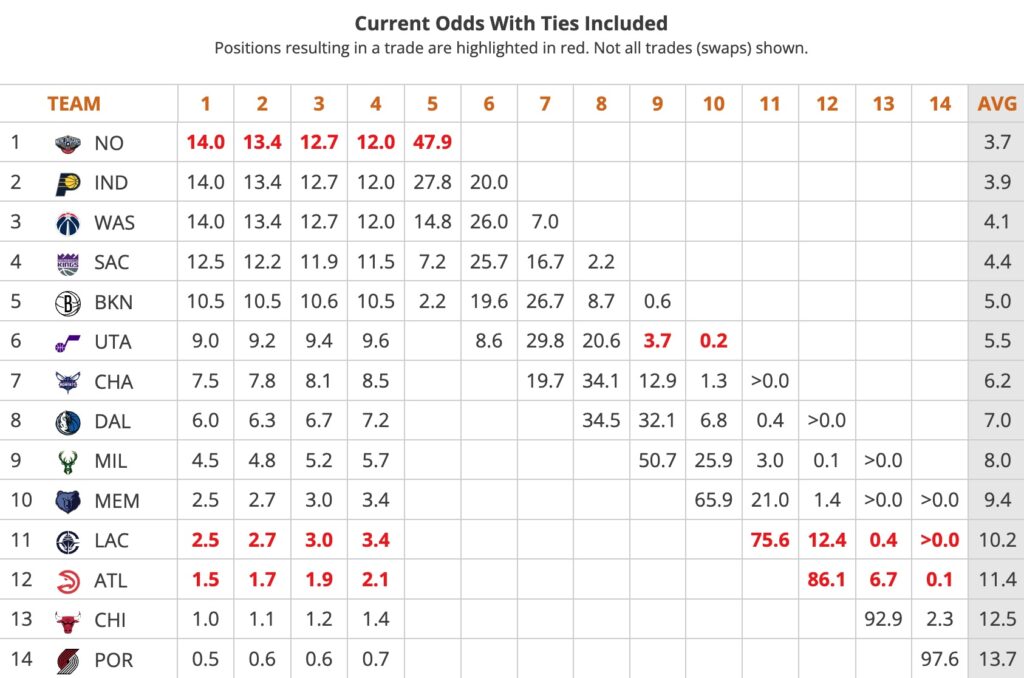
Everybody knows the deal. The Jazz can keep their 2026 draft pick if it is at eight or better. Utah would like to finish with a bottom six or worse record to have good odds at keeping the pick (96%, see the current odds table near the end of the article) and having at shot at a higher pick in the lottery (~30%-40% odds to get a top three pick if they finish with the sixth worst record). Prior to this week, the Mavs sat at eighth worst, a half-game ahead of the Jazz at seven.
The Mavs were without Cooper Flagg for last week’s games: ankle sprain, a legitimate injury, we saw it happen. Anthony Davis was also out (naturally) with a damaged hand. The Jazz had listed Markkanen out with illness (maybe he was sick, maybe he wasn’t, who knows?). But that wasn’t enough it seemed. The Mavs are a lottery competitor after all. If you are conniving to secure your lottery pick you certainly don’t want to beat the Mavs of the world or the Charlotte Hornets (see worst lost in history to Charlotte several days previous), or the Nets. The Jazz had beaten the Mavs in SLC the week before. They could not afford to win another one against them. And so, the Jazz rolled out a new tanking hack in Dallas—just keep healthy, available good players on the bench and replace them with lesser players.
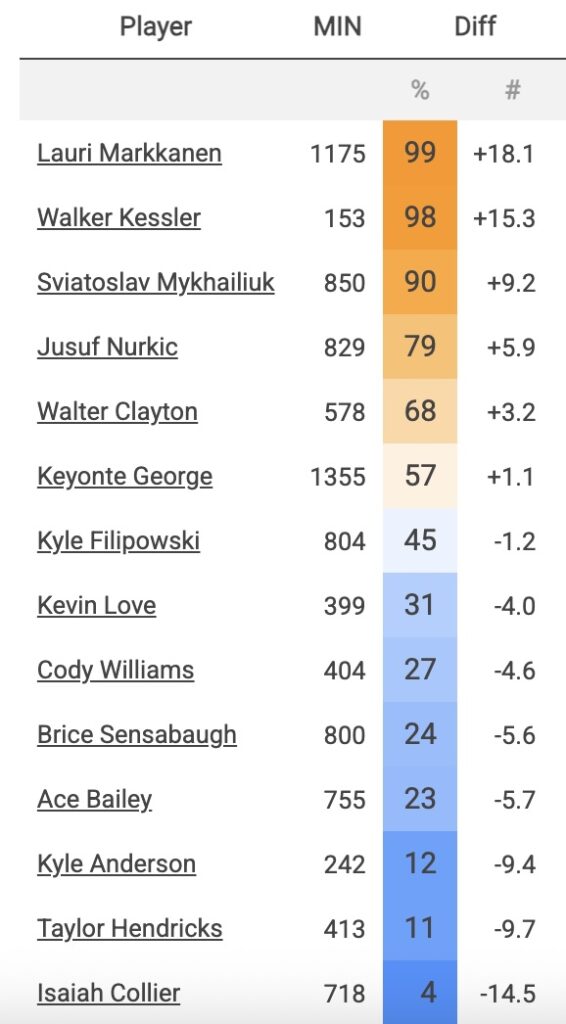
There are only five active Jazz players this season that are having a positive impact on the team’s scoring “differential” (efficiency differential1); that is, the points the Jazz score during a game (100 possessions) compared to what their opponents score. Those players are (see table to the left) Lauri Markanenn, Svi Mykhailiuk, Jusuf Nurkic, Walter Clayton, and Keyonte George. The rest are negative. Sit one of these positive players and replace them with a negative player and you’re more likely to lose—that’s what the numbers tell you.
The Jazz sat a healthy Svi (positive player) in back to back games with the Mavs last week–Isaiah Collier (a big negative differential player) took most of those starter minutes instead. But the Jazz often often sit Svi in favor of playing their younger guards… nothing too wrong there. No, the new, bolder wrinkle was sitting a healthy Jusuf Nurkic (dressed and smiling on the bench) and replacing him at center with Kyle Anderson of all people. Slow-Mo Anderson is not part of the player development priority and he’s not a center. But he is a massive negative efficiency player–the Jazz efficiency differential is almost 14 points worse with Nurkic out and Anderson in. With Flagg and Davis out for the Mavs, the Jazz could take no chances.
The switch-a-rue worked to perfection. What had been predicted to be two close games by the odds makers turned out to be ugly blowouts (Utah 122 / Dallas 144 on Jan. 15 and Utah 120 / Dallas 138 two days later). Utah was playing three points guards at a time, Anderson at the five, and chalking up the losses. By the end of the week the Jazz had dropped two full games in the rankings to the Mavs and had moved up from seventh to sixth draft position—mission accomplished.
Sad but true
The Anderson for Nurkic tactic the Jazz pulled off in Dallas last week is just one example of odd lineup moves that seem to have no benefit to player development or competitiveness. Local Jazz apologists have told us that these strategies are all part of the growth process. Maybe some are. But some are clearly not. Some have nothing to do with development and everything to do with intentionally hamstringing an already down-trodden team toward losing more games than they should.

Not much that is happy happens when these moves are made. Nothing positive as far as entertainment value, team play, or player development. The only purpose that we can see for such manipulations is to ensure the Jazz get another swing at another rookie.
These losing strategies may be the right move in the end. I mean, how many Piston fans are whining about losing 28 straight in 2023-24 after all. They’ve got Cade Cunningham now and are in first place in the east. But regardless of how good, or bad, this journey ends for the Jazz, we were lied to along the path. And the lie takes a lot of the fun out of it all.
Walter Clayton said what fans are thinking a few weeks ago—“we’re tired of losing.” Well, that’s to bad because Jazz management is not. Not just yet.
- Efficiency Differential. Say that the Jazz, on average for the season, score 8 fewer points per game (per 100 possessions) than their opponents score. Then the Jazz scoring differential is -8 points. Say that Jusuf Nurkic’s efficiency differential is +6 points when he is on the court (as shown in the table in this article). That means that when Nurkic is playing, the Jazz team differential is -2 (-8 +6) or 6 points better than when he is off the court. ↩︎